
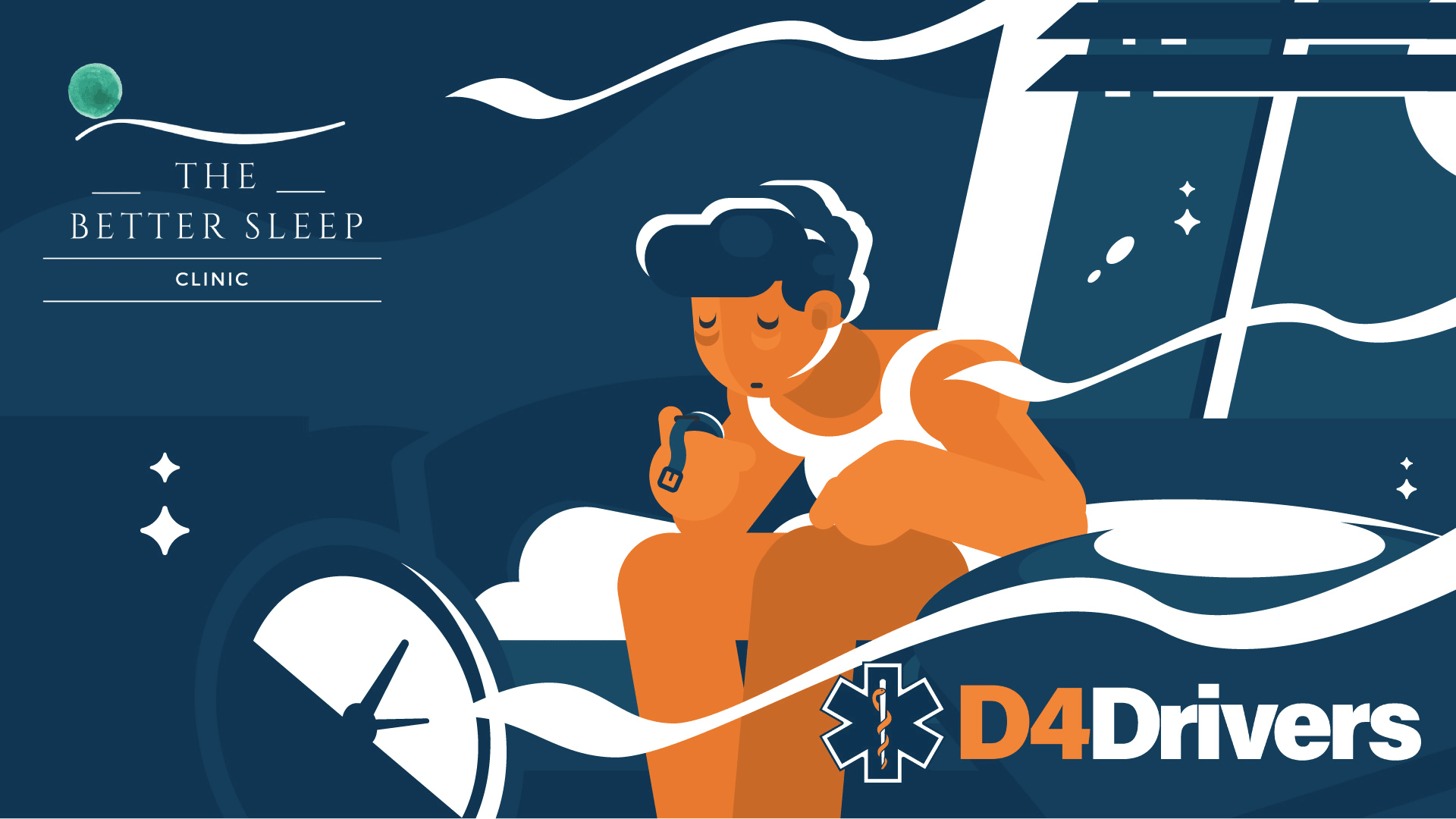
How did you feel last time you had poor sleep? Fatigued, exhausted, low in mood, unable to concentrate? Like a zombie?
Imagine this happening for a week. Or a month…Or a year. Persistent poor-quality sleep has a much more sinister impact on our health and wellbeing.
The Impact of Poor Sleep
Persistent poor sleep puts us at significantly higher risk of physical health problems such as cardiovascular disease and diabetes, and mental health conditions such as depression and anxiety.
It also greatly increases our risk of having an accident on the road. So, what does this mean for vocational drivers?
The Impact of Sleep on Performance
Sleep is a key driver of focus, attention and vigilance. In fact, when you are sleep deprived, there is good evidence that shows the degree of impairment in attention is similar to that of alcohol.
Going 24 hours without sleep gives the same level of impairment as a blood alcohol concentration of 0.1% – this is over the limit 1*.
You wouldn’t drink and drive. Would you drive while sleep deprived?
Sleep and Vocational Drivers
Several sleep disorders are more common among vocational drivers –
Obstructive Sleep Apnea
Obstructive sleep apnea is a sleep disorder usually associated with loud snoring where the upper airway repeatedly closes when you sleep.
This leads to a pause in breathing, known as an apnoea. The body can only tolerate this for so long before it has to pull you back to a light stage of sleep, or completely awake, so your airway opens again.
This leads to extremely fragmented and poor quality sleep. So even if you sleep for 10 hours you still wake up feeling unrefreshed and feel excessively sleepy throughout the day.
You can find yourself falling asleep in meetings, and the great concern is if you fall asleep behind the wheel.
A very challenging statistic is that 85% of those with obstructive sleep apnea are undiagnosed 2*.
Shift Working and Insomnia
Another common problem with sleeping among vocational drivers is due to the impact of shift work.
One of the main systems that controls our sleep is called the circadian rhythm. This is also known as the internal body clock and is the natural rhythm or cycle that our bodies have that tells us if it is day, or night.
If we have to work night shifts and be awake during the night while our body tells us to be asleep, this can lead to excessive levels of sleepiness.
It can also mean that when we’re trying to sleep during the day after our night shift, our body tells us to be awake, which further disrupts our ability to sleep and recover.
Sleepiness and Driving
The number one fear is that a vocational driver may fall asleep at the wheel, which can have catastrophic consequences for both the driver and other road users around them.
But falling asleep at the wheel is not the only risk. If we are sleepy, we have a reduced perception to risk – we drive faster, might overtake where there isn’t room, we’ll find ourselves tailgating the car in front.
Sleepiness leads to reduced attention which means we might not be vigilant for road users in our blind spot, or might not see the turning coming up and have to make a last minute change of direction.
All of this significantly increases our risk of a vehicle accident. One in five road accidents are related to poor sleep 3*.
It negatively impacts our ability to focus and concentrate.
What does this mean for vocational drivers, who suffer significantly more issues with sleep than the rest of the population?
What is the Solution?
Whilst it goes without saying that drivers with reduced attention are more likely to be involved in collisions, many drivers are still driving despite having sleep apnea.
Driver sleepiness often flies under the radar, due to fear of DVLA implications.
It is very rare for a driver to lose their license due to a sleep disorder. Not coming forwards means that drivers continue having the damaging effect of poor sleep, and driving at high risk on the road.
The DVLA is very clear that the driver must be fit to operate a vehicle safely however more and more operators are now realising that they have vicarious liability for their drivers and need to be able to demonstrate, through proper screening and assessment, that their driver is just as roadworthy as the vehicle which they drive.
Conversations around the risk of poor sleep and driving need to be more widespread. There needs to be education for both drivers and employers on the risks of poor sleep, and reassurance on the DVLA processes.
After education, there needs to be an efficient and streamlined service for sleep apnea testing and treatment, and getting drivers back on the road as soon as possible.
Poor sleep can be effectively treated, and drivers who fix their sleep are happier, healthier and safer.
If you employ vocational drivers and want to know more about how you can support their sleep, please visit our website: https://www.thebettersleepclinic.co.uk/
References
1*. Williamson AM, Feyer AM [2000]. Moderate sleep deprivation produces impairments in cognitive and motor performance equivalent to legally prescribed levels of alcohol intoxication. Occup Environ Med 57:649-655.
2*. Kato M., Adachi T., Koshino Y., Somers V. K. Obstructive sleep apnea and cardiovascular disease. Circ J. 2009
3*. Lyznicki JM, Doege TC, Davis RM, Williams MA. Sleepiness, driving, and motor vehicle crashes. JAMA 1998
- Book your medical here – https://book.d4drivers.uk
- Check out our business packages here – https://d4drivers.uk/business-packages/
- Link to the Health and Safety Executive – https://www.hse.gov.uk/workplacetransport/index.htm